Multi-venue
City festivals
Events like Manchester Psych Fest spread bands across several venues in one city. Log it as a single festival with its location and the acts you saw, rather than a pile of separate gigs.
Festival tracker app
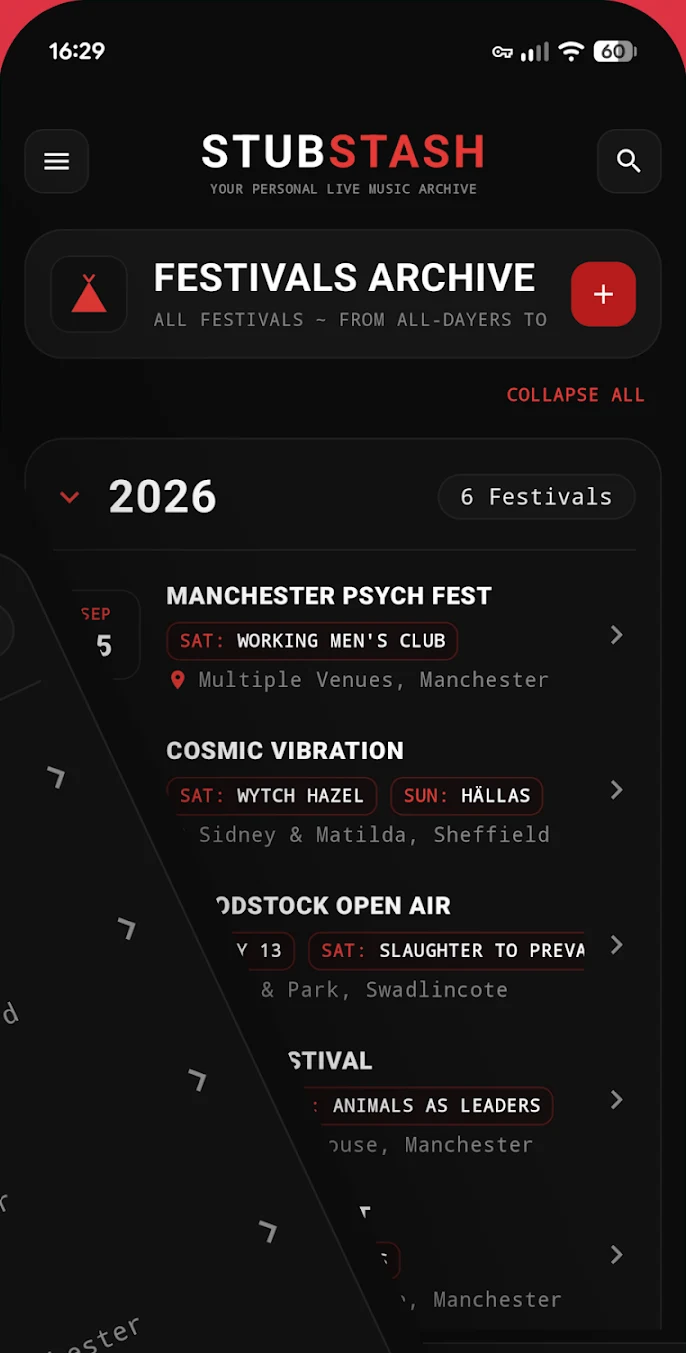
StubStash is a festival tracker app that keeps a proper record of every festival you've been to: the year, the site, who headlined each day, the bands you discovered by accident on a side stage, what the ticket cost and what you'll want to remember in ten years.
From city all-dayers to muddy camping weekends, your festival history ends up in one place instead of scattered across wristbands and a camera roll.
The problem
A normal gig is easy to pin down. One night, one venue, a headliner and a support act or two. A festival is a different beast. You might see fifteen or twenty bands over a weekend, across three or four stages, and by the Monday it has all blurred into one long, loud day.
The headliners stick, mostly. It's the undercard that disappears: the band you wandered into while queuing for food, the opener on the second stage who turned out to be your highlight of the weekend. Ask yourself who you saw on the Saturday afternoon of a festival five years ago and you'll probably draw a blank.
Was it Friday or Saturday that the sound cut out? Which year did it rain all weekend? Festivals repeat, often at the same site with a familiar feel, so different years merge in your memory in a way that single gigs rarely do.
The one device that could have kept a record is usually on 4% by Saturday night, and the photos it did manage are a jumble of blurry stage shots with no clue which band was playing. Ticket confirmations sit in an old inbox, and the wristband ends up in a drawer or the bin. A dedicated festival log fixes that, as long as it's quick to fill in.
It's worth the effort. Festivals are usually the biggest live music outings of the year: the most bands, the most money and the most stories. Being able to look up which year you first went to a festival, or the weekend you saw a band before anyone had heard of them, is half the fun of keeping a festival history at all.
What to record
You don't need to log every minute. A good festival diary captures the details that are hardest to recover later:
Get those down and you've got a festival history worth looking back on.
How it works
StubStash gives festivals their own archive, separate from your one-off gigs. Every festival is grouped by year, so you can scroll back through your summers in order.
Each festival carries lineup tags for the days you were there, along the lines of "SAT: Wytch Hazel" and "SUN: Hällas". At a glance you can see who you watched and on which day, which is exactly the detail that goes missing first.
The location sits with each festival, so Bloodstock Open Air at Catton Park, Swadlincote, reads differently from an all-dayer at Sidney & Matilda in Sheffield.
Log each day's headliners and the undercard acts you caught, record what you paid, and keep your festival memories with the entry rather than buried in your camera roll.

Every kind of festival
Multi-venue
Events like Manchester Psych Fest spread bands across several venues in one city. Log it as a single festival with its location and the acts you saw, rather than a pile of separate gigs.
Smaller events
Smaller events such as Cosmic Vibration at Sidney & Matilda in Sheffield pack a lot of bands into a short space of time. They're easy to forget and quick to log.
Under canvas
Multi-day festivals like Bloodstock Open Air at Catton Park get a headliner and undercard for each day you were on site, plus the ticket price and your memories of the weekend.
Festival logging checklist
Add the festival with its name, year and location, and record the ticket price while the confirmation email is still easy to find.
Before your phone dies, jot down that day's headliner and any band that surprised you. Thirty seconds is enough.
Fill in the gaps for each day: undercard acts, the set of the weekend, who you went with, what the weather did.
Go through the camera roll while you still know which band is which, and write up your festival memories before the details fade.
The bigger picture
Festivals are where a lot of us find new favourite bands. That opener you caught on a Sunday lunchtime could be the band you go on to see five more times. In StubStash, bands you log at a festival also appear in your artist directory, the A–Z index of every band you've seen live, showing when, where and how many times.
So the trail is all there: the festival where you first saw them, then every headline show after it. If you also want to keep track of your regular nights out, the gig diary page covers logging one-off shows, and our guide on how to remember every concert has tips for piecing together old festivals from ticket emails, bank statements and photo dates.
Festivals live in their own archive, but they're part of the same live music history as your concerts and Battle of the Bands nights. With the optional StubStash Pro upgrade you also get concert analytics like average ticket price and top-seen artists, plus On This Day throwbacks showing what you were watching on this date in previous years.
StubStash is free on Google Play for Android. See everything else it does on the StubStash homepage.
FAQ
Give each festival its own entry with the year, location, each day's headliners, the undercard bands you caught and what you paid. StubStash has a dedicated festivals archive for exactly this, grouped by year with day-by-day lineup tags.
Yes. StubStash lets you track multi-day festivals with daily headliners, undercards, ticket prices and festival memories, so a Friday-to-Sunday weekend sits in one entry with each day's lineup tagged.
Yes. A multi-venue city festival such as Manchester Psych Fest is logged as one festival with its location and the bands you saw each day, just like a camping weekend at a single site.
Yes. StubStash's artist directory is an A–Z index of every band you've seen live, showing when, where and how many times, so a band you stumbled on at a festival sits alongside the bands you've seen at headline shows.
StubStash is free to download on Google Play and contains ads. There is an optional in-app upgrade, StubStash Pro, which adds personal concert analytics, an On This Day nostalgia feed and removes ads.
StubStash is an Android app, available on Google Play.
Keep exploring
feature
Log every concert you've been to: headliners, support acts, venues, prices and ratings.
Read more →feature
A digital gig diary for UK music fans, with every gig, venue and ticket stub in one place.
Read more →feature
See how many gigs you've been to, your average ticket price and your most-seen artists.
Read more →